Learning to Speak of Collective Trauma: ELICIT at Manotsava 2025


ELICIT has been working in the mental health space since 2017, beginning with one school in Kashmir, and a deep conviction that education must respond to the realities of a place. In conflict-impacted regions, this has meant designing education with wellbeing at its core. Yet, until recently, we hesitated to place ourselves explicitly as innovators within the mental health ecosystem.
Much of mental health practice in India, and in dominant global imaginations, continues to be clinical, individualised, and rooted in pathology. People are understood through diagnoses. Even where there is an acknowledgement of social context, there are fewer-than-necessary models that meaningfully engage with affect, collective agency, and the impact of conflict on psycho-social systems.
When entire communities have lived through prolonged violence, uncertainty, or loss - when bodies, behaviours, and nervous systems have adapted to survive,what does it mean to work with trauma at a collective level? This question sits at the heart of our work. It is also what led us to apply to the National Mental Health Festival 2025 (Manotsava), organised by Rohini Nilekani Philanthropy and NIMHANS. We wanted to bring nearly nine years of learning from conflict-impacted classrooms into a wider mental health conversation; our attempts to understand patterns of behaviour through data, our struggle to quantify the intangible, and the articulation of core habits we believe children need to build. We wanted to share how something as simple, and as complex, as cultivating curious distance can become a practice of empathy.
There was much to hold, and much to condense. Designing our presence at Manotsava felt like a challenge in itself. As with all our work, we returned to a few guiding questions to design: How do we make this experience hopeful? How do we invite curiosity? How do we create just enough discomfort for reflection?
Some design choices became clear early on. We needed a game, something experiential that could carry the nuance of our work. We wanted students’ voices present, through their art, poems, and written reflections. We wanted to introduce our vocabulary and core habits as invitations to dialogue with us.
Designing for this audience forced us to see our own work anew. We had to pare things down, sit with language, and find clarity without flattening complexity. Over two days, the stall became a site of many conversations; some fleeting, some deeply engaged. We spoke with researchers, school leaders, therapists, students, NGO practitioners, and others who were simply drawn in by curiosity. Again and again, we were met with warmth and a quiet sense of awe, not just at the work, but at the insistence on doing it.
Many questions circled around data. People were curious about how we translate affective indicators, our core habits, into something readable and meaningful. How do we track collective trauma? How can schools become places where such data points signal hope rather than harm? What surprised us most was the depth of interest in the process: the how.
The game became a powerful entry point into that. Participants had to navigate volatility, respond to shifting circumstances, and make decisions while keeping well-being non-negotiable. As they played, they found themselves struggling with uncertainty, with emotional regulation, with the unpredictability of others. For many, this opened up a felt understanding of the space we work in, far beyond what explanation alone could offer.
As a team, Manotsava felt like a moment of arrival. It marked a shift of standing more firmly in our identity as practitioners who are reimagining mental health through education, from within conflict-impacted regions. This feels like a beginning: of speaking to the world from these places, of building knowledge rooted in lived realities, and of offering narratives that emerge from the heart of conflict rather than its margins.
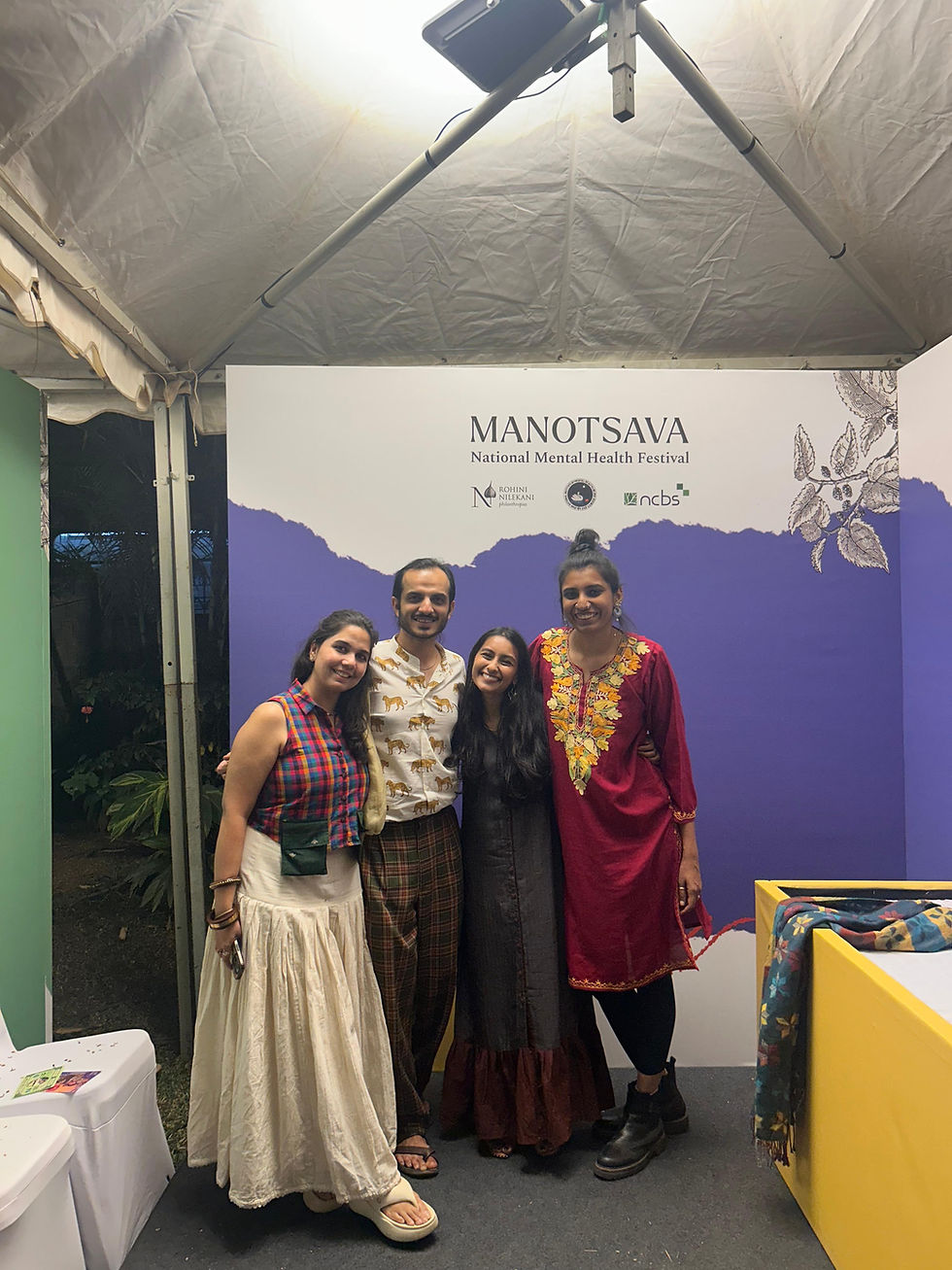
Team ELICIT (minus our founder and fellows. Missed them!)


Comments